

Inside the AI Music Scam Through Streams

The music industry is facing a new kind of piracy powered not by downloads, but by algorithms.
As AI tools make it effortless to produce entire albums in seconds, streaming platforms are now flooded with machine-generated tracks. Deezer recently estimated that nearly one in five new songs uploaded each day is AI-made, translating to tens of thousands of fake releases entering the system daily.
These aren’t underground experiments. They’re part of a growing black market where fraudsters upload thousands of low-cost, AI-generated tracks and use bot farms to simulate plays, earning real royalties from fake streams. It’s an arbitrage model at scale including exploit automation, mimic engagement, and cash out before detection.
Platforms are trying to keep up. Spotify says it has deployed entire teams and advanced detection systems to flag and penalize offenders, while Apple Music insists that fewer than one percent of streams on its platform are manipulated. Yet, in a global streaming market worth over $20 billion, even a fraction of that activity translates into hundreds of millions in fraudulent payouts every year.
Industry insiders say this wave of streaming fraud began to spike around 2021, when generative music tools and self-service distribution platforms converged. Since then, combating fake streams has ballooned into a major operational challenge. One music distribution executive recently admitted that half of his company’s daily workload now revolves around identifying and removing fraudulent activity.
Behind the data lies a simple truth: how easy content can be created nowadays, and the incentive to monetize it, has turned streaming into fertile ground for exploitation. And just like in sponsored ads, where fake clicks and bot impressions inflate metrics, the same logic of synthetic engagement now threatens to rewrite what “success” means in music.
How the Scam Works
The scam starts with one simple fact: it’s cheap to make content and easy to fake attention.
Fraudsters use AI music generators to create endless tracks, such as ambient piano pieces, lo-fi beats, relaxing rain sounds, anything algorithmically pleasant and easy to replicate.
Once created, they upload thousands of these tracks to streaming platforms through low-cost distribution services. The process takes minutes, and each upload looks legitimate on the surface: metadata, album art, and even fake artist names generated by AI.
From there, the manipulation begins.
- Bot farms and click farms simulate thousands of streams per track.
- The platform’s algorithm sees the artificial “engagement” and begins recommending these tracks more widely.
- Each fake stream earns a fraction of a cent in royalties. However, at scale, those fractions turn into real profit.
- Repeat the process across hundreds of fake accounts, and you’ve built a fraud factory powered by automation.
It’s the same principle behind display and app ads PPC click (CPC) fraud or fake ad impressions (CPM): manufacture engagement cheaply, get paid by the system, and disappear before detection.
How AI Bot Farms Turn Fake Streams into Real Profit
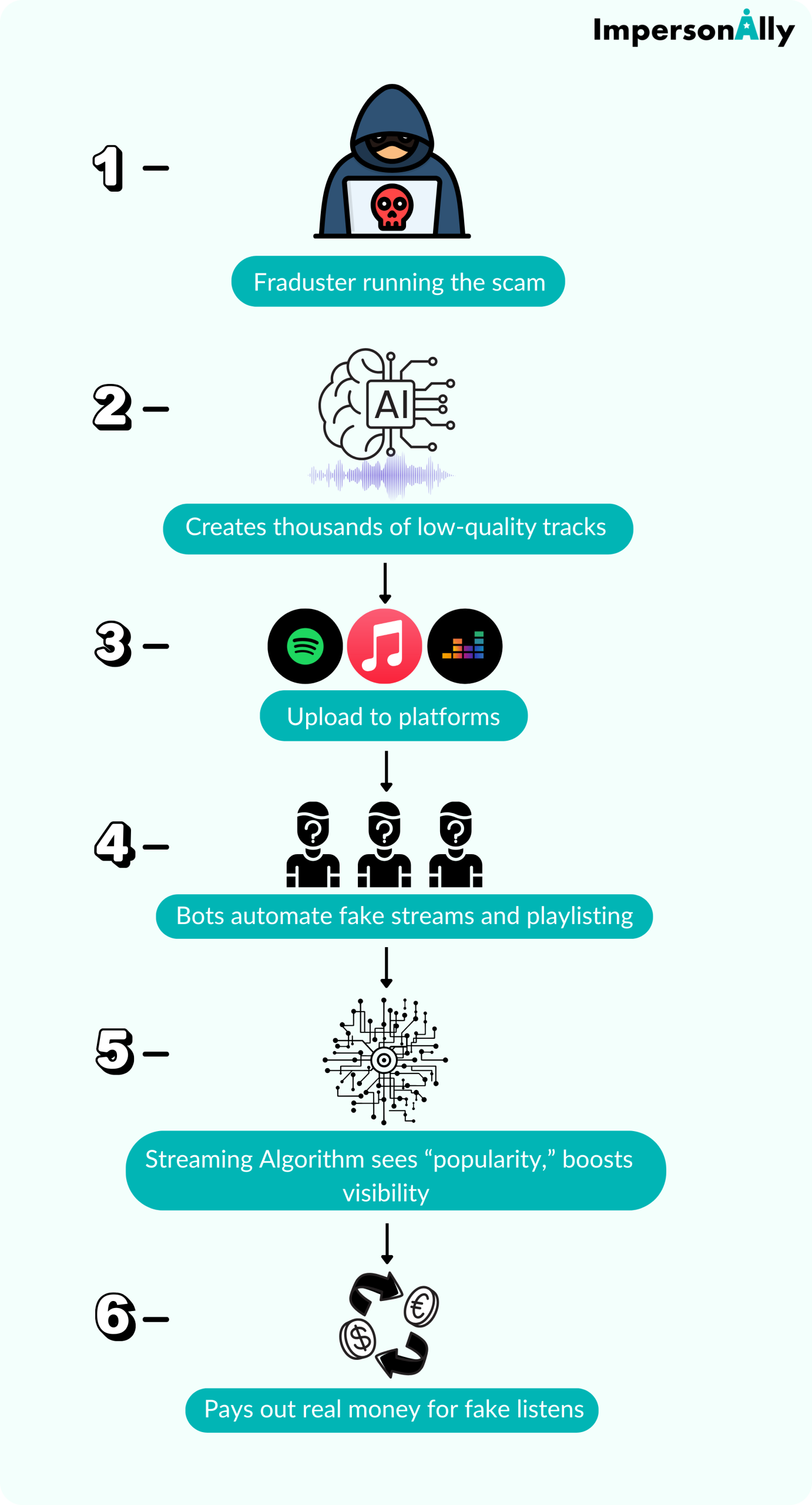
At its core, this is an arbitrage model, scammers exploit the difference between cost and payout.
Let’s break it down with approximate numbers:

For every few hundred dollars spent automating fake engagement, they can earn multiples back in real royalties. Multiply this by hundreds of fake “artists” and millions of fake streams, and the numbers add up fast.
In April 2025 alone, Deezer reportedly detected over 20,000 AI-created songs uploaded daily — and that’s just one platform.
The Collateral Damage: Real Artists Flagged as Fraud — and Advertisers Losing Money
Here’s where it gets worse: in their attempt to fight streaming fraud, platforms are often penalizing the wrong people.
The bots that boost fake songs also distort detection systems. When the algorithm detects “suspicious spikes” in plays, it automatically flags the account or removes tracks.
That means legitimate indie artists, especially those who suddenly gain attention after a playlist feature or viral moment, can be mistakenly accused of fraud.
The Guardian report includes artists whose music was taken down without warning, royalties frozen, and accounts restricted, all because the system assumed they were part of the scam.
But there’s another group caught in the same storm: the advertisers.
When streaming platforms fill their catalogues with bot-generated tracks, ad inventory gets polluted. Brands paying for “premium placements” end up showing their ads between fake songs, to fake listeners, wasting millions on impressions that never reach real people. Each fake stream isn’t just an inflated number in an artist’s dashboard, it’s a micro-loss for the companies funding the ecosystem.
So the cycle feeds itself: AI scammers pump out fake content. Detection algorithms overreact and silence genuine creators. Meanwhile, advertisers keep spending into a system that’s quietly rewarding fraud with every fake listen.
In the end, real artists lose credibility, and real advertisers lose money, while the fraudsters hidden behind synthetic accounts and AI music factories walk away with both.

Platform Vulnerabilities
Streaming services face the same problem advertisers do: they reward engagement, not authenticity.
- Low upload barriers → anyone can publish “music” instantly.
- Automated payouts → royalties are triggered by plays, not verification.
- Algorithmic discovery → fake engagement drives visibility, compounding the fraud.
- Delayed detection → it takes weeks or months before fake streams are caught.
In ad tech, this is known as ad stacking, click spamming or similar practices, when fake impressions, clicks, or ad placements distort the real market. The same principle applies here: fake supply inflates perceived success, eroding value for everyone involved.
Why It Matters Beyond Music
This isn’t just a music problem. It’s a preview of how AI and automation are reshaping fraud across industries.
- In advertising, bots generate fake clicks to drain competitor budgets.
- In search, impersonators use fake landing pages to hijack brand traffic.
- In social media, AI personas amplify content for political or commercial gain.
All these tactics rely on the same principle: manipulate a metric, profit from the system.
The streaming scam exposes a larger truth, that in the digital economy, engagement has become currency, and wherever there’s currency, there will be counterfeiters.
Trust Is the Real Metric
The rise of AI-generated fraud, whether in ads, music, or content, shows one thing clearly: the platforms built for scale were never built for verification.
As automation lowers barriers, fraud becomes not just easier, but more industrialized. The solution isn’t to slow innovation but to build smarter systems that verify authenticity before rewarding engagement.
For artists, marketers, and platforms alike, the question is the same:
How do we ensure that visibility, whether it’s a stream, a click, or a conversion, actually means something?
Because when metrics can be faked, trust is the only real measure left.


Subscribe to the newsletter
Your Brand Protection Ally
Are your Ads being Impersonated by others?
Author
